

Change may be more important to your business than ever before as technology, customer expectations and competitors evolve at an ever-increasing pace, but against the busy backdrop of the normal day-to-day, how can you plan it, sell it to the team and deliver it without taking your eye of today’s vital targets.

The definition of change agent is:
A group or individual whose purpose is to bring about a change in the entrenched practices or routines of an Organization.
So, when you hire a change agent you are outsourcing the responsibility to deliver change but not, I would suggest, the design and logic around which the change is commissioned.
In the discovery phase you must share with your change agent the outcomes you desire, the challenges that you face and detail about every element, person and process within the business model that will be affected. You must decide if the vision for the company is to be yours a lone, or if it will be a shared design involving your senior leadership team.
A plan co-authored by the senior leadership team is both desirable and much easier to deploy but as the business leader you must be prepared to commit to a collaborative design process. You can influence, sell your vision and veto any suggestions you simply can’t get behind, but once the process starts you must do more than listen to the options of the SLT, you must hear them and incorporate those ideas that gain a strong consensus. You will need the change agent to chair the process and coach you with honest feedback that your team may not feel able to provide. This is the key element so must not be rushed. You must have a clear and shared vision before committing to the rest of the process.
When the vision has full Clarity the change agent will take your team through the remaining steps, starting with perhaps the hardest Honesty.
In the business model you are running you will have strong players and weaker players within the team, but all probably have a good value. Likewise, within your suppliers you will have the most supportive and revenue critical and others of diminishing importance.
In order to deliver the new vision, there may need to be some painful choices in this section. What works today may not fit with your future. People who can deliver at your current level may be at their capacity and cannot make the step up required within the new strategy, becoming instead and anchor that holds you back.
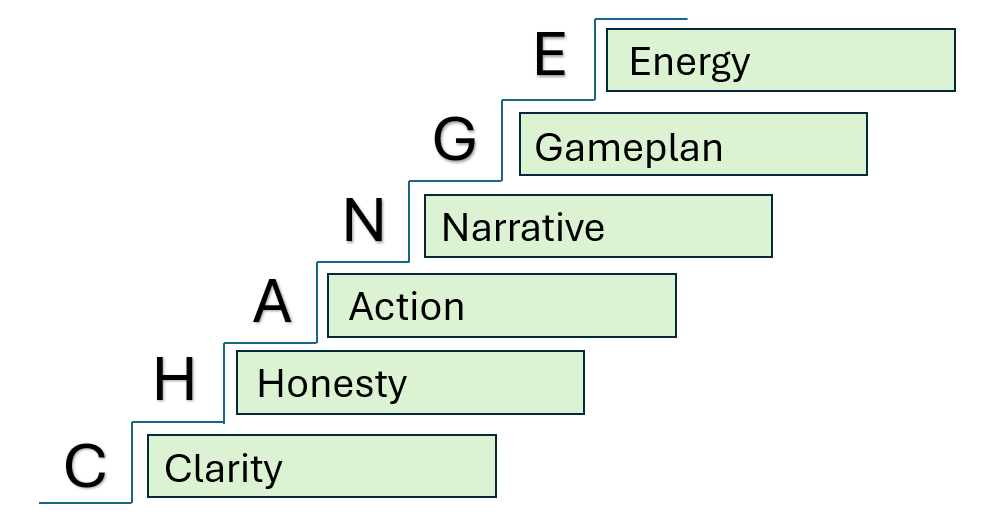
The required actions and the order in which they can be delivered will dictate both the speed of transition and the people who will need to balance change management with everyday responsibilities. Simple things like holidays, critical orders, events and supplier contracts will all need to be mapped into the plan before you start to communicate it to the wider team. Whilst all generals will tell you no plan survives the first engagement with the enemy, it does cement the starting position, the principal objectives and the overall goals, so diligence and again honest intel are vital at this stage.
To achieve the growth you are looking for you will need to bring everyone with you on the journey; suppliers, customers, staff and their families/friends. The narrative is the Why, the banner around which everyone can rally and the justification that encourages a surge of commitment and extra effort. If everyone understands the vision, the plan of action and the shared benefits the outcome will deliver, and believes that this is the change the business needs, you are almost certain of success.
The Gameplan is the manual against which the project will be delivered, and it will be drafted and owned by the change agent, however the responsibility for each element within it will be owned by the SLT. Remember the change agent is a finite player in your infinite game, they are your additional resource, a conductor helping the different sections of your team engage at the right time and with the right tempo.
Change is hard, it takes time, effort and like ascending Ben Nevis your collective will may be challenged by prevailing conditions, injuries and fatigue. The energy you set off with will strongly influence the depth of buy-in and personal commitment you get from each member of the team. The energy you inject at the different phases of the gameplan will be important to sustain people through periods of doubt, frustration and personal challenge. You and your SLT must own this. The change agent will continually test the energy levels of the team and advise when they need a boost, but before the mission starts you will need to identify what your business equivalents of energy drinks, electrolytes and jelly-babies are.
I often refer to the change process as being like a hike up a UK mountain because the thought of it is exciting, the planning is straightforward, the risks understandable and the outcome truly rewarding, however like the three peaks challenge or simply accenting one of them, they are not to be underestimated and a poor plan in the wrong conditions could create real problems for your business. A change agent is like adding a mountain leader to your party to ensure safety, overcome challenges and make the experience relaxed, fun and with the highest possible chance of reaching the summit. When you hire one, recognise that you and they will share the ownership of the mission. You will become a team for the duration of this mission and quite possibly for the next one in 3 or 5 years!